
Source of Insight: This Director Insight is based on S. Karume (2026), “Repositioning the Teacher in AI-Enhanced Learning Systems: A Framework for the Transition from Content Authority to Cognitive Architect,” presented at the EDULEARN26 Conference, Palma, Spain, 29 June–1 July 2026, and published in the Proceedings of EDULEARN26. DOI: 10.21125/edulearn.2026.0923.
- THE DIRECTOR'S INSIGHT
Generative AI is changing the educational environment. AI systems can increasingly provide explanations, generate content, offer feedback, summarise information and support problem-solving. The question facing universities is therefore no longer simply whether AI should be used in teaching and learning, but how teaching should be redesigned when AI is already part of the learner's cognitive environment.
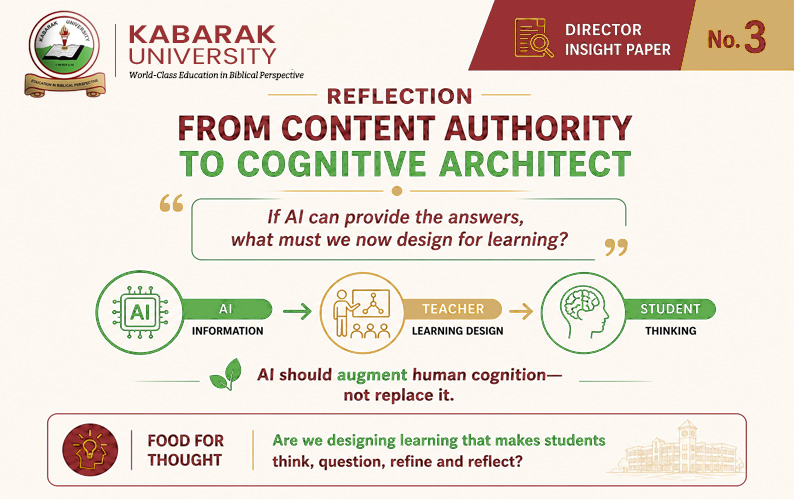
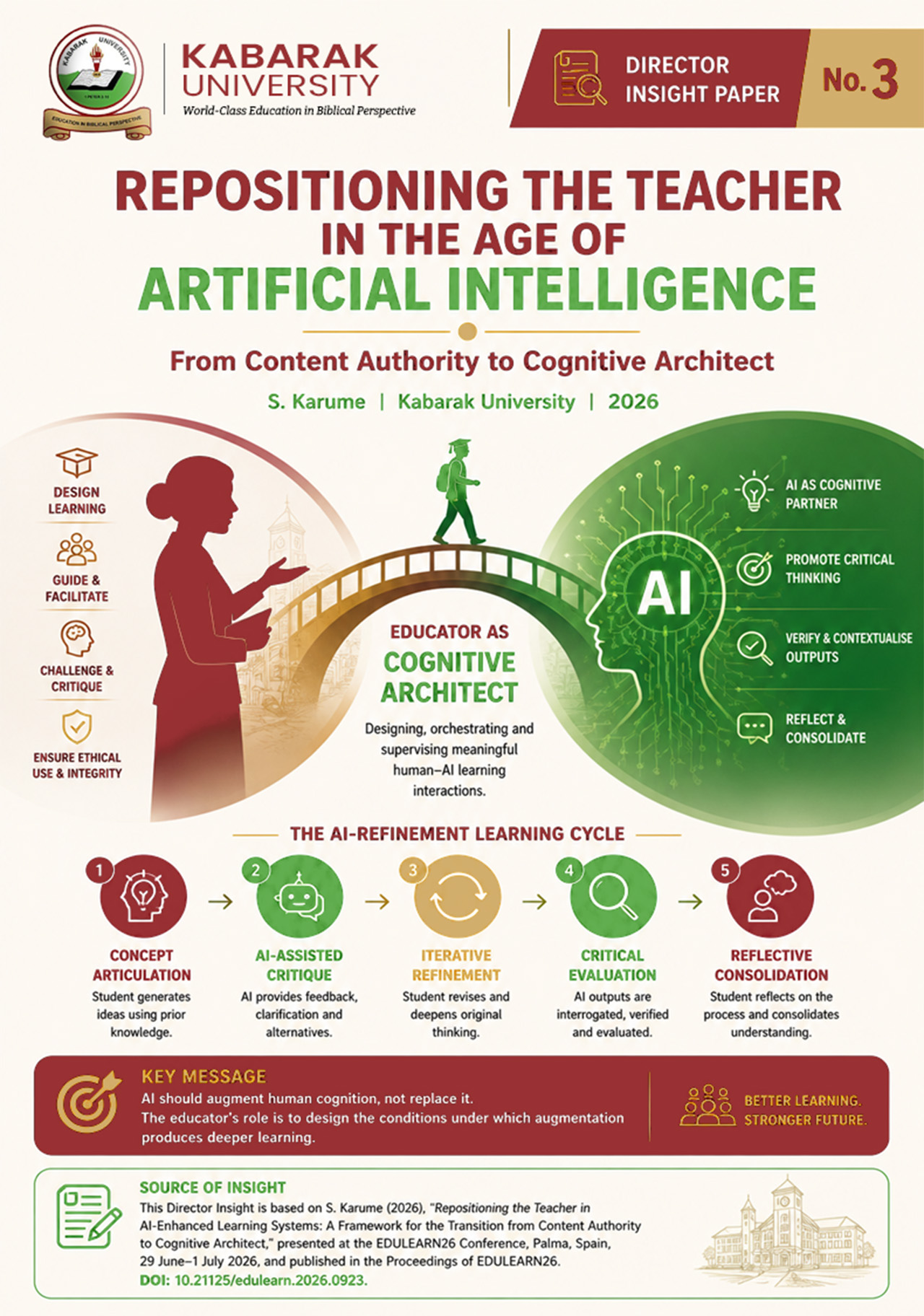
Karume (2026) argues that this transformation requires a fundamental repositioning of the educator from content authority to cognitive architect. As AI increasingly performs functions traditionally associated with information provision and routine academic assistance, the distinctive contribution of the educator shifts towards designing, orchestrating and supervising meaningful learning interactions between students and AI.
- FROM CONTENT AUTHORITY TO COGNITIVE ARCHITECT
The proposed Teacher Role Transition Model describes four progressive orientations:
Traditional Content Authority → Facilitator of Learning → AI-Mediated Learning Orchestrator → Cognitive Architect
The progression does not make the teacher less important. It moves the teacher's contribution to a higher pedagogical and cognitive level.
The cognitive architect designs the learning environment, determines when and how AI should be introduced, structures student–AI interaction, guides verification and critique, facilitates reflection, and maintains human intellectual responsibility.
The future educator is not simply a user of AI; the educator is an architect of human learning in an AI-mediated environment.
- THE AI-REFINEMENT LEARNING CYCLE
The paper complements the teacher-role model with an AI-Refinement Learning Cycle comprising five stages:
- Concept Articulation: the student first generates and explains ideas using prior knowledge.
- AI-Assisted Critique: AI provides feedback, clarification, and alternative perspectives.
- Iterative Refinement: the student revises and deepens the original thinking.
- Critical Evaluation: AI-generated outputs are interrogated, verified and evaluated.
- Reflective Consolidation: the student reflects on the learning process and consolidates understanding.
The sequence is important because it places human cognition before and after AI interaction:
Think → Engage AI → Critique → Refine → Evaluate → Reflect
AI therefore becomes a cognitive partner, rather than a substitute for thinking.
- WHY THIS MATTERS
The paper's bibliographic analysis illustrates the scale of the challenge. Google Scholar results for “Generative AI” AND “Education” increased from 74 in 2020 to 21,500 in 2025. Yet research specifically addressing the teacher as facilitator within AI learning environments remained very limited, with only nine results identified in 2025.
The implication is significant:
Technological development is moving faster than pedagogical theorisation.
Universities can no longer treat AI adoption simply as a matter of acquiring tools, training users or developing acceptable-use policies. The deeper task is to redesign the pedagogy surrounding AI so that technology strengthens critical thinking, reflective learning, contextual reasoning and intellectual responsibility.
- WHAT THIS MEANS FOR UNIVERSITY LEADERS
Faculty development should move beyond “How do I use AI?” towards “How do I design learning in which AI improves thinking?”
Curriculum design should deliberately determine where students work independently, where AI is introduced and how its outputs are interrogated.
Assessment should give greater attention to reasoning, critique, verification, reflection and demonstrated understanding—not merely the production of a final answer.
AI governance should connect responsible AI use with pedagogy, curriculum, assessment, faculty development and academic integrity.
- THE STRATEGIC QUESTION
The most important question for university leaders is no longer:
How do we prepare our academics to use AI?
It is:
How do we prepare our academics to redesign learning for the age of AI?
Access to AI technologies is becoming increasingly widespread. The more enduring institutional advantage will therefore lie in the capacity to design high-quality human–AI learning environments.
- CONCLUSION
Generative AI is changing the relationship among the learner, the teacher, knowledge, and technology. The appropriate institutional response is not simply greater AI adoption, but pedagogical transformation.
The Teacher Role Transition Model and AI-Refinement Learning Cycle provide a framework for this transition. Together, they reposition the educator from content authority to facilitator, orchestrator, and ultimately cognitive architect, while positioning AI as a resource for inquiry, critique, refinement and reflection rather than a substitute for human cognition.
The value of AI in education will depend not only on what AI can do, but on how intelligently educators design the learning around it.
SELECTED REFERENCES
- Collins, A., Brown, J. S., & Newman, S. E. (2018). Cognitive apprenticeship: Teaching the crafts of reading, writing, and mathematics. In Knowing, Learning, and Instruction (pp. 453–494). Routledge.
- Holmes, W., Persson, J., Chounta, I. A., Wasson, B., & Dimitrova, V. (2022). Artificial Intelligence and Education: A Critical View Through the Lens of Human-Centred Learning. Council of Europe.
- Holmes, W., & Miao, F. (2023). Guidance for Generative AI in Education and Research. UNESCO Publishing.
- Karume, S. (2026). Repositioning the teacher in AI-enhanced learning systems: A framework for the transition from content authority to cognitive architect. Proceedings of EDULEARN26 Conference, Palma, Spain, 29 June–1 July 2026. https://doi.org/10.21125/edulearn.2026.0923.
- Kasneci, E., et al. (2023). ChatGPT for good? On opportunities and challenges of large language models for education. Learning and Individual Differences, 103, 102274.
- Mollick, E. (2024). Co-Intelligence: Living and Working with AI. Portfolio.
- Schön, D. (1983). The Reflective Practitioner: How Professionals Think in Action. Basic Books.
- Vygotsky, L. S. (1978). Mind in Society: The Development of Higher Psychological Processes. Harvard University Press.
CIRCULATION NOTE
This paper is circulated internally within Kabarak University to stimulate reflection, digital learning policy dialogue, and collective learning on emerging issues in open, distance, and e-learning.
Staff are encouraged to share insights or responses through the KABUODeL Discussion Forum or the Director's email: