
The second day of the 16th Kabarak University International Conference Week saw research activities spread across multiple venues as schools hosted specialized conferences aligned to their disciplines. While the School of Business & Economics continued its conference sessions in the University Auditorium and the School of Education, Humanities & Social Sciences convened at the Katiba Auditorium, the School of Science, Engineering and Technology (SSET) officially launched its conference track at the Sawia Auditorium.
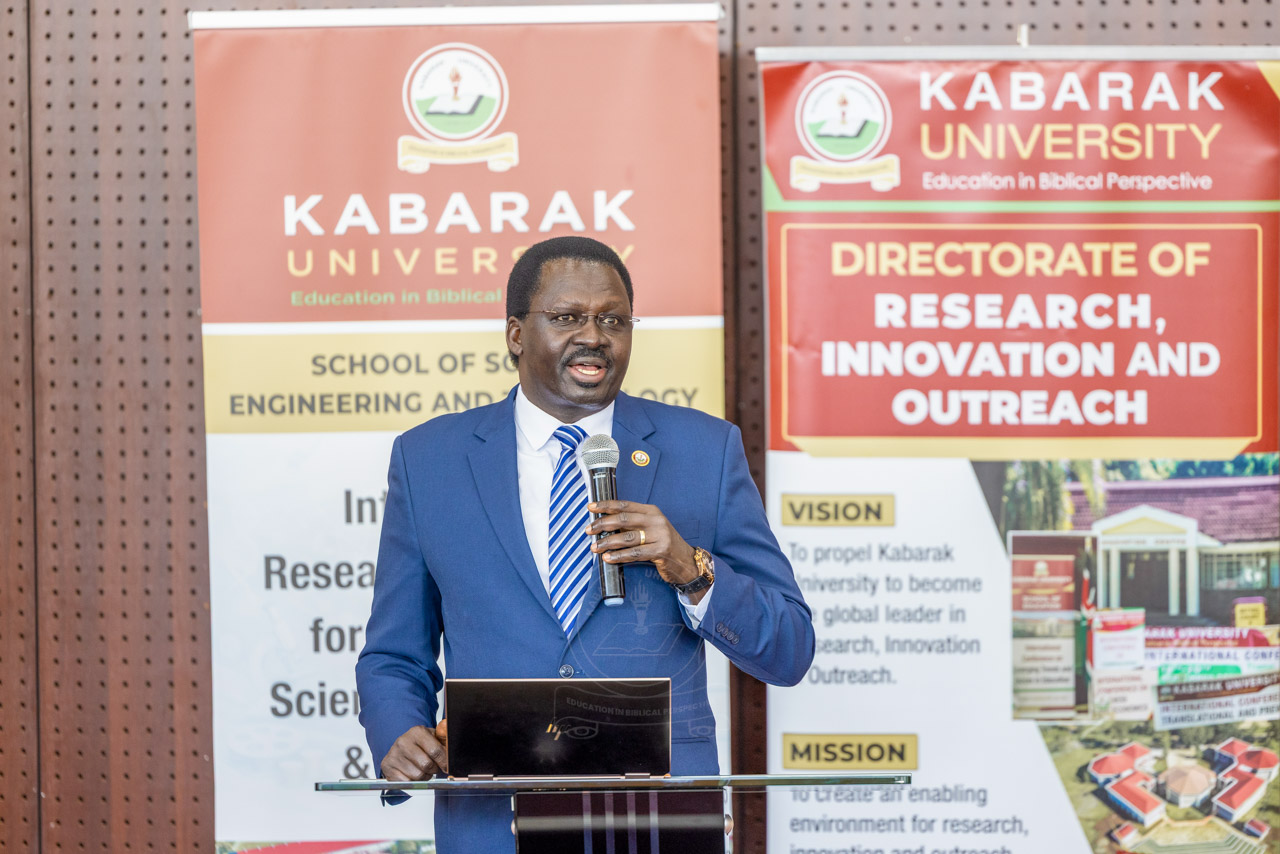
The SSET conference was officially opened by Vice-Chancellor Prof. Henry K. Kiplangat, who welcomed participants and highlighted the importance of research in addressing some of the world's most pressing challenges. Speaking under the conference theme, "Sustainable Futures through Science, Technology and Community Innovation," he noted that societies today are navigating complex issues ranging from climate change and environmental degradation to food security, public health concerns, and rapid technological change.

Prof. Kiplangat observed that sustainable development cannot be achieved through technology alone. He emphasized the need for a balanced approach that combines scientific excellence, technological innovation, and meaningful community engagement. According to the Vice-Chancellor, lasting solutions emerge when research moves beyond laboratories and classrooms to address real challenges facing communities, economies, and ecosystems.
He further challenged researchers to harness emerging technologies such as Artificial Intelligence, Big Data Analytics, the Internet of Things, cloud computing, and remote sensing to advance sustainable development while ensuring that innovation remains ethical, inclusive, and environmentally responsible. He also underscored the importance of collaboration between researchers, policymakers, industry leaders, entrepreneurs, and communities in developing practical solutions with lasting impact.
The keynote address was delivered on behalf of Dr. Nelson Tanui Maara, Nakuru County Executive Committee Member for Water, Environment, Energy, Climate Change and Natural Resources, by Ms. Grace Karanja, Director for Water, Energy and Environment in Nakuru County.

In the keynote presentation, participants were challenged to view research as more than an academic undertaking. The address emphasized research as a critical driver of innovation, policy development, economic growth, and community transformation. Drawing attention to current global challenges, the keynote highlighted the need for locally relevant solutions informed by both scientific inquiry and indigenous knowledge systems.
A major focus of the keynote was the growing role of Artificial Intelligence and Green Information and Communication Technology in shaping sustainable futures. The presentation explored how AI-driven solutions can support climate modelling, environmental monitoring, precision agriculture, urban planning, water resource management, and disaster preparedness. Participants were also encouraged to ensure that technological advancement remains sustainable, accessible, and responsive to societal needs.
The keynote further emphasized that sustainable development depends on strong partnerships among universities, government institutions, industry, development partners, and local communities. Researchers and students were encouraged to pursue work that responds to real-world challenges and contributes meaningfully to policy and development outcomes.

Following the opening session, delegates engaged in panel discussions before breaking into paper presentation sessions where researchers shared findings across diverse areas of science, engineering, technology, sustainability, innovation, and community development.
Elsewhere on campus, the School of Business & Economics continued its second day of presentations and discussions, featuring guest engagements, panel sessions, and research paper presentations focused on contemporary business and economic issues. At the Katiba Auditorium, the School of Education, Humanities & Social Sciences hosted scholars, researchers, and practitioners for discussions covering education, humanities, social sciences, and related fields.

The ongoing conferences form part of the University's International Conference Week, whose overarching theme is "Reimagining University Education for an AI-Driven, Competency-Based Future." Through the various school-based conferences, Kabarak University continues to provide a platform for knowledge exchange, interdisciplinary collaboration, and research-driven solutions that contribute to national and global development.


