

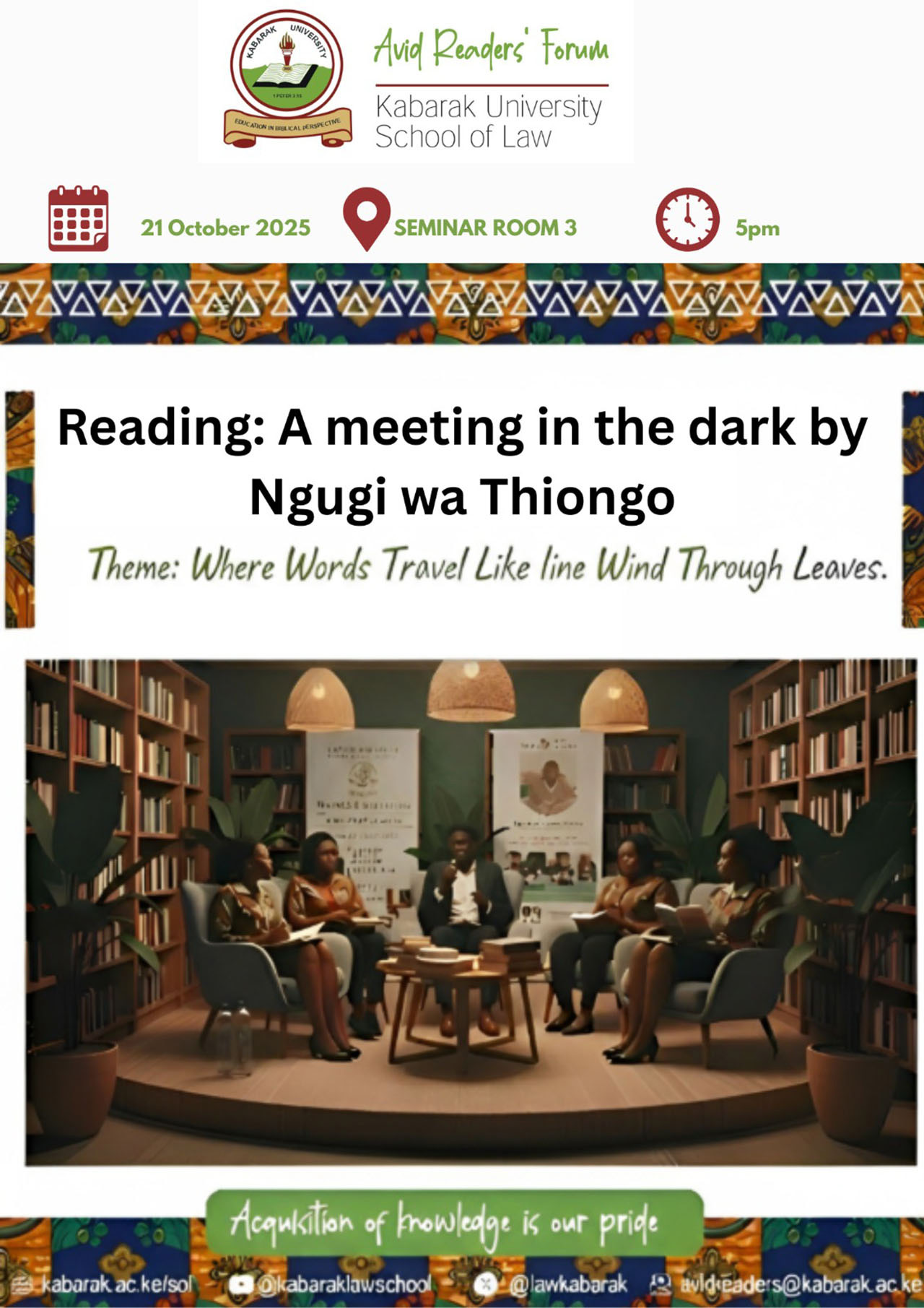
On 21 October 2025, the Avid Readers Forum convened a thought-provoking session on Ngũgĩ wa Thiong’o’s short story “A Meeting in the Dark.” The discussion was led by Narah Yegon, a second-year law student at Kabarak University School of Law, and attended by other law students and a faculty member. The session involved a collective reading of the story, with participants taking turns to read various parts aloud before engaging in an analytical discussion.
The Reading Session
Ngũgĩ wa Thiong’o’s short story “A Meeting in the Dark” explores the tragic conflict between traditional African values, Christian morality and personal identity in postcolonial Kenya.
The story follows John, a young man who has completed the white man’s education in Kenya and is preparing to pursue further studies at Makerere University. He embodies the clash between two worlds, the Christian education imposed by colonial missionaries and the traditional culture upheld by his community. His father, a strict Christian convert, expects him to live according to rigid religious standards, while his mother often confronts the father over his harsh treatment of John.
John’s inner turmoil intensifies when he impregnates Wamuhu, a local girl considered “pagan” by Christian standards. Fearful of his father’s reaction and the shame it could bring, John becomes trapped between guilt, fear and the pressure of societal expectations. The story reaches a tragic climax when, in a desperate moment of panic and repression, he accidentally kills Wamuhu during a confrontation.
Through this narrative, Ngũgĩ critiques the psychological violence of colonialism and Christianity, showing how imposed Western values can alienate African youth from their roots and humanity. The “meeting in the dark” symbolizes both the literal encounter leading to Wamuhu’s death and the figurative darkness of identity confusion, moral hypocrisy and colonial legacy.
In essence, the story is a powerful commentary on postcolonial identity crisis, generational conflict and the destructive effects of cultural alienation brought about by missionary influence and colonial domination.
Discussion and Q&A session
Following the reading, an insightful and interactive Q&A session ensued, guided by the lead reader. The discussion focused primarily on the role of Christianity in shaping societal values in early African communities, particularly through education. Participants observed that missionary education at the time, as illustrated by John’s scholarship, was reserved for a select few who conformed to Christian moral standards, often marginalizing those who upheld traditional African beliefs.
The forum also explored gender disparities in education, highlighting Ngũgĩ’s depiction of limited educational opportunities for women. It was noted that the few girls who attended school rarely advanced beyond the lower classes, reflecting persistent gender inequalities in access to education during the colonial period.
Another key area of discussion was John’s internal conflict, symbolizing the broader cultural tension between Christianity and African tradition. As the pastor’s son, John was torn between maintaining his Christian image and following his heart by committing to Wamuhu, a traditionally circumcised and uneducated girl. The participants discussed how John’s struggle to balance societal expectations, personal desires and fear of losing his scholarship to Makerere University mirrors the psychological conflict faced by many Africans during the colonial and postcolonial periods.
The dialogue further emphasized Ngũgĩ’s critique of colonialism and its divisive impact on African identity. John and his father were portrayed as products of colonial influence, adhering to Western moral codes while remaining alienated from their cultural roots. The irony of John’s father’s strictness, despite his own moral failings, was cited as an example of the hypocrisy bred by the fusion of Christian dogma and patriarchal authority.
In conclusion, participants unanimously agreed that Ngũgĩ wa Thiong’o’s “A Meeting in the Dark” offers a compelling reflection on the complex intersections of religion, education, and identity in postcolonial Africa. The story exposes how Western religion and education disrupted traditional African structures, creating a generation caught between two conflicting worlds. Through John’s tragedy, Ngũgĩ underscores the enduring consequences of cultural dislocation, moral rigidity and colonial legacy on African society.
Conclusion
The session concluded with Narah Yegon closing the discussion and inviting Victoria Okeke and Cedric Kadima to give the final remarks. Victoria Okeke gave an overview of who the author was and Mr. Kadima delivered a vote of thanks, expressing appreciation for the participants’ active engagement and consistent attendance. He commended the students for their analytical contributions and encouraged them to continue attending future reading sessions organized by the Avid Readers Forum.
