

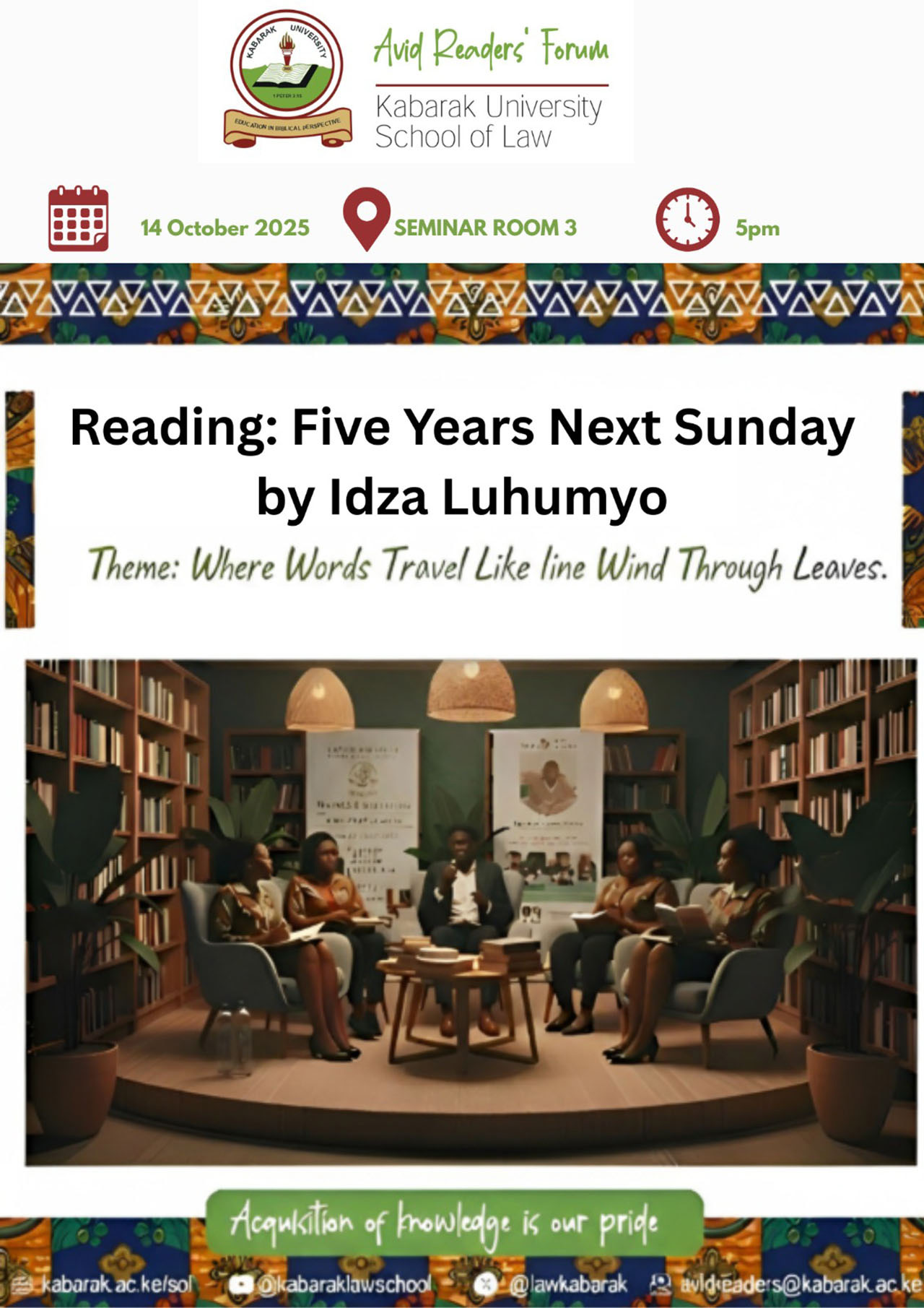
On 14 October 2025, the Avid Readers Forum convened for a reflective reading and discussion of Idza Luhumyo’s short story Five Years Next Sunday. The session was moderated by Asheen Chepkosgei and attended by law students and a faculty member, drawn by the story’s haunting exploration of scarcity and survival. Participants engaged in a collective reading, moving through the narrative in turns before interrogating its themes, symbolism, and moral questions. The session sought to unpack how fiction mirrors social realities in which human dignity is continually negotiated against material need.
Summary of the Story
Luhumyo’s Five Years Next Sunday imagines a fragile community where rain is rare and hope even rarer. At the centre of the story is a young girl whose extraordinary hair possesses the mystical ability to summon rain. What begins as wonder gradually mutates into a mechanism for survival as her family discover that the hair can be monetised. The girl’s body becomes a site of economic production, and affection toward her shifts from love to calculation.
Through spare yet lyrical prose, Luhumyo portrays how scarcity erodes moral boundaries. Acts that would ordinarily be unthinkable—selling strands of a child’s hair, bartering her presence for food, measuring her worth in coins and harvests—become reasonable within a starving world. The narrative quietly questions whether exploitation is born from cruelty or from desperation disguised as care. The girl herself moves between pride in helping her people and a growing sense that something essential is being taken from her.
The story’s climax arrives when she cuts off her hair to bring the long-awaited rain. The act is both sacrifice and rebellion: a final offering to the community but also a refusal to remain a perpetual instrument of need. Luhumyo leaves the reader with uneasy rain where life is restored, yet innocence spent, thus forcing reflection on what societies demand from their most vulnerable.
Highlights of the Discussion
Lead discussant Asheen Chepkosgei opened by noting the author’s delicate balance between magical realism and social critique. Participants examined how scarcity compresses morality, shrinking the space between right and necessary. What begins as gratitude toward the child gradually curdles into entitlement; the miracle ceases to be sacred and becomes a commodity with market value.
Readers drew parallels with real communities where poverty turns relationships transactional, where children work to feed families, and gifts of nature are mined until exhausted. Some viewed the parents as victims of circumstance rather than villains, while others argued that desperation does not absolve exploitation. The group debated whether the girl’s final act was liberation from bondage or tragic surrender to collective pressure.
Symbolism of hair as identity and power attracted keen interest. Cutting it was read as both self-authorship and erasure, echoing wider tensions between individual agency and communal expectation. Participants also reflected on the silence of the narrator, whose inner voice contrasts with the loud demands around her, revealing how children often carry the heaviest burdens without language to resist.
Conclusion
Asheen Chepkosgei concluded by observing that Luhumyo offers no easy villains or heroes, only a society squeezed by want and people making painful bargains with conscience. The session closed with remarks from the student coordinator, Victoria Okeke, who thanked attendees for a thoughtful engagement and encouraged members to continue exploring contemporary African voices at future Agora meetings.
