

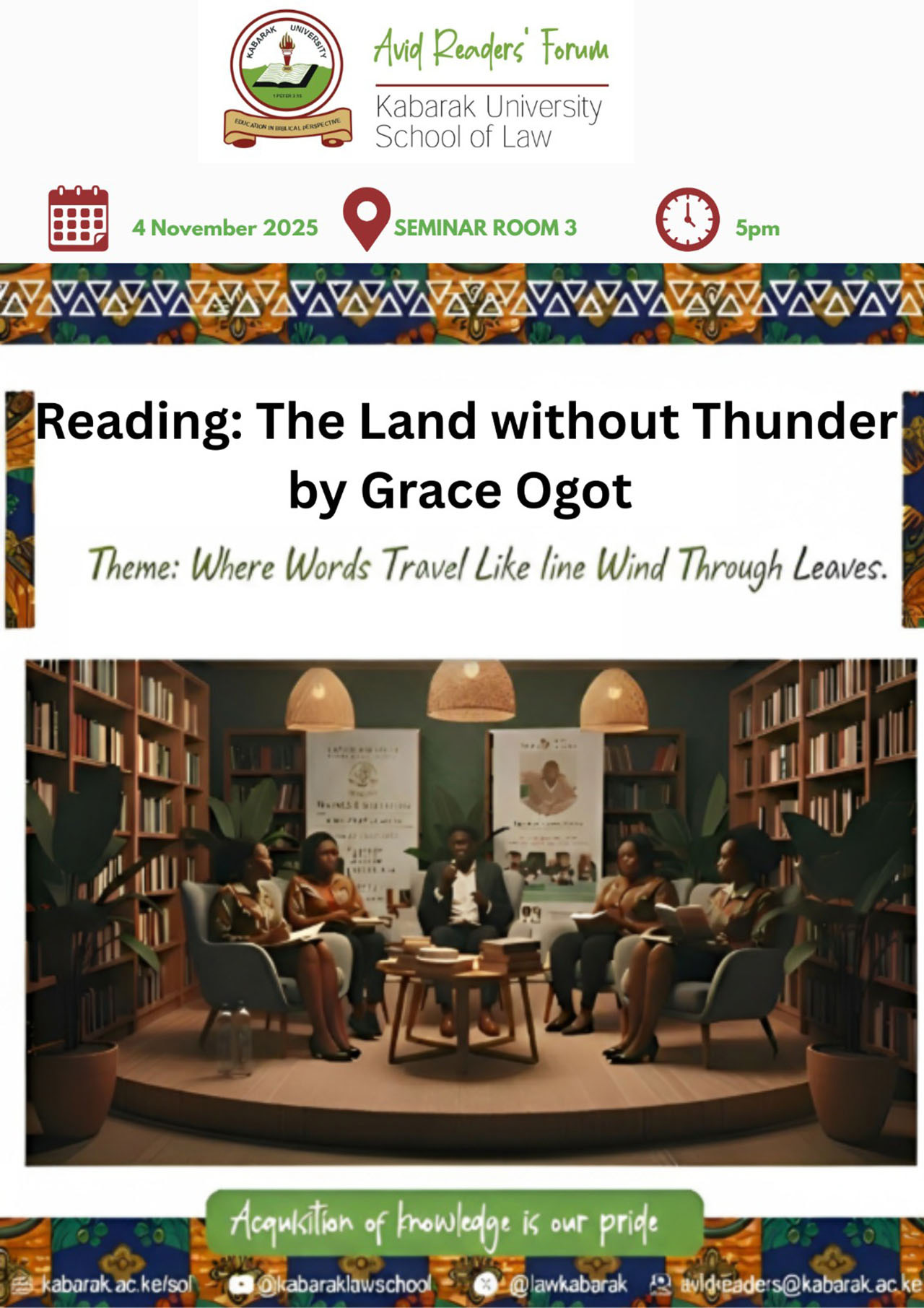
On the 4th of November 2025, the Avid Readers’ Forum met for yet another spirited and intellectually stimulating discussion on Grace Ogot’s short story “Land without thunder.” The lead reader for the day’s session was Billheart Braxton, a second year law student at Kabarak University. From the outset, it was clear that this was more than a literary conversation, it was a deep dive into the psychology, spirituality, and artistry embedded in African storytelling.
Summary of the Story
Land Without Thunder follows Owila, a fisherman from the lakeside village of Agok, who ignores spiritual warnings and ventures onto Lake Victoria with his cousins, Obuya and Ochuonyo. A sudden and violent storm capsizes their canoe, drowning the others and leaving Owila as the sole survivor. Though rescued days later, he is haunted by the voices and images of his dead cousins, who seem to beckon him back to the lake. The community, interpreting his trauma as the spirits of his cousins being angry with him, performs cleansing rituals to free him from the spirits. However, when lightning later strikes his hut and destroys the ritual charm, the haunting resumes. To escape the curse, Owila is sent to stay with his relative, Oyugi, in Mombasa “the land without thunder.”
His mind improves until Oyugi's children fall seriously ill and scream that someone is strangling them. Oyugi's wife, Ambajo, blames Owila for the misery that befalls her children. Clan elders advise Oyugi that Owila’s cousins are angry and he should return home to appease them. Driven out by Ambajo’s wailing, Owila sadly leaves Mombasa, feeling tired, confused, and unwanted.
Discussion Highlights
Braxton opened the floor for discussion on what the attendees’ view on the story was. Members started off by highlighting how nature was given personhood in the story especially when it came to the lightning with some stating that thunder and lightning symbolize divine justice, nature’s way of reclaiming balance after human defiance. This comment opened up a greater discussion on the same. Some saw the lightning and thunder as manifestations of guilt and conscience, natural forces humanized by cultural imagination with others noting how even vivid descriptions of the lake “swollen and angry,” and “waves hissing like whispers” were not just symbolism but rather evidence of the personification of nature. The lake emerged as a character in its own right: a mother, a monster, a mirror of the human soul.
Another subject of discussion that resonated with the group was the conflict between tradition and modernity. Owila rejects formal education to embrace the traditional occupation of fishing, symbolizing loyalty to ancestral ways. Yet these same traditions later become his prison when he is trapped within the spiritual interpretations of his suffering. The group saw this as Ogot’s subtle commentary on postcolonial Africa, a society caught between inherited beliefs and new ways of understanding the world.
The aspect of survivor’s guilt also came up in the discussion with some members empathizing with Owila’s torment, interpreting it as the psychological burden of outliving loved ones. They noted how his haunting voices could represent post-traumatic stress disguised within the language of spirits of the dead. Others viewed it more spiritually, suggesting that African societies often blend the physical and metaphysical to make sense of suffering.
The Agora also examined the power of shared belief within African communities. Members noted how the people of Agok responded to Owila’s survival with both compassion and fear. The cleansing rituals, sacrifices, and consultations with medicine men all reflected communal attempts to restore order when the natural and spiritual worlds collide.
Conclusion
The session ended with a deep appreciation for Ogot’s craftsmanship and the layered complexity of Land Without Thunder. Victoria Okeke, the forum’s student coordinator, thanked the attendees for the wonderful and engaging session. She while encouraged the members to continue with their passion for reading and attendance in the Avid Readers’ Forums. The session was finally closed off with a word of prayer from Rebecca Muhindi, a member of the forum.
