

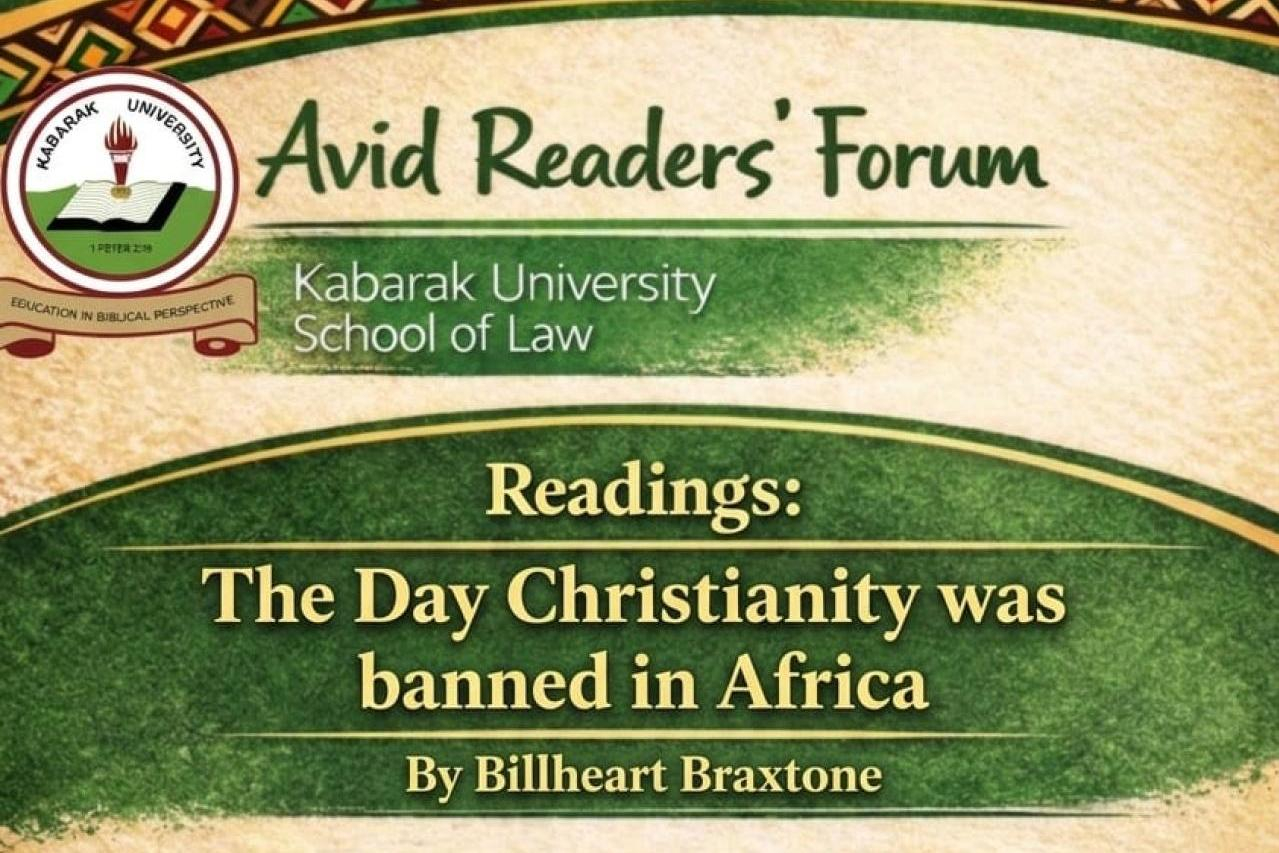
When it comes to outshining themselves, Kabarak Law Students seem to have a knack. Sharing a stage with a seasoned Kenyan artist during the Cultural Week Gala Night pales in comparison with having your writing dominate the subject of discourse in the same arena as renowned authors such as Chinua Achebe. Our very own Billheart Braxtone shared in this honor when discussions of the Avid Readers’ Forum were directed by his The Day Christianity was Banned in Africa.
Honor goes hand in hand with modesty and this author portrayed sufficient amounts when he reserved his remarks on the muse of his work, which ultimately informed his insights, for later. This is worthy of acknowledgment since much alike to previous texts traversed here before, authors’ insights have been uncharted, affording discussants as far from a biased discussion as humanly possible. It is never an easy feat distancing opinion from belief informed by experiences and personal bias, especially with as controversial a subject as religion, as the discussion soon revealed.
Strong sentiments were aired with regard to how subscription to religion was devoid of choice. The less conservative Christians in the room made a claim that most were only Christians because they were born of Christian families. In the same vein, it was posited that Islamic practitioners would have been atheists had they been born of atheist parents. The more conservative, leaning dangerously towards fundamentalist, defended their position in the Christian community as having been informed not just by choice but also a strong conviction to be affiliated with the Messiah.
It was argued that this choice was heavily informed by faith as opposed to belief; a stark comparison coming up between the two. Belief came up as a mental position characterized by a recognition in the mind. Based on evidence, experience or even reasoning, belief portrays itself as a mental judgment about reality. Faith, however, is based on a more surreal foundation. Trust, commitment and reliance were claimed to play a crucial role in laying the basis for faith. Belief is when the mind accepts something to be true whereas faith was seen as more of life leaning on that truth. Such abstract arguments were not unexpected, let alone peculiar in such a subject as religion.
Speaking of fundamentalist notions, caution was paid to dogmatic fellowship that discouraged critical questioning. It was for such reasons as ‘blind faith’ that the mass killings witnessed in Shakahola in a promise to see Heaven, were perpetuated with such ease. A little questioning was encouraged to build a more stable foundation on which faith and religion rested. As portrayed in the text, Victory had a battle with faith following the ban imposed on Christianity. She had to take refuge in a foreign religion to quench her parched spirit. In this conquest, having experienced different perspectives, her return to Christianity was even more profound because her reasons were not alien to perspective.
The text itself carried a load to reflect upon. ‘Three months before the ban, the continent did not tremble. It shimmered.’ Such a line could only provoke as strong a thought as how subtly insidious change comes about in political spaces. An abduction here, a battered journalist there, next thing you know, constitutionalism has no place in a politically oppressed society. However, on a more optimistic lens, this unnoticeable gradual progression provides a hopeful avenue. Political revolution does not always spark from loud protests or war. There are more refined, often quiet contributions to revolutionary change, like the Agora forum where such controversial discussions are had.
Notably, when the author speaks of billboards appearing across Africa claiming, ‘Faith Must Evolve’, it begs the question - evolve into what? Who decides the direction of the evolution? Reading this, we are brought alive to the fact that language used by the political class often sounds intelligently progressive, while in a real sense, it is simply an opening to further oppression through unfettered discretion to control such personal factions of life.
Economy si ni ya bottom up? Ama namna gani my friend.
Leaving that room, pensive faces were worn; a cocktail of subjects indulged. However, just as promising as the futures of Kabarak Law Students capable of provoking such substantial discourse, is the future of our political independence when we have such fora as the Agora as the sentry at the gates of intellectual discourse.
