

The Contribution of Alliance High School to the Leadership of Post-Colonial Kenya
Session Overview
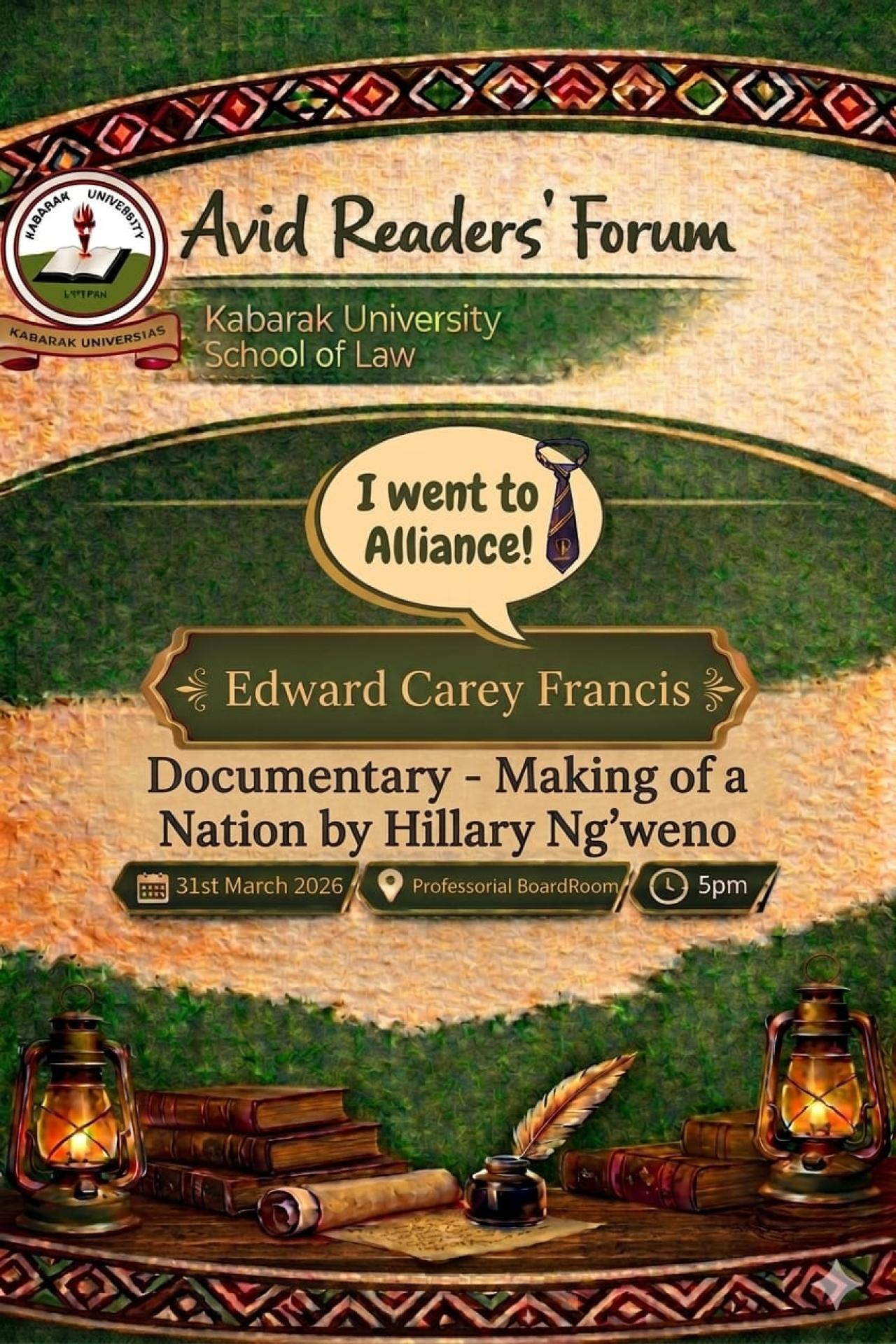
On Tuesday, 31st March, 2026, we, the members of the Avid Readers Forum converged at the Professorial Boardroom in our prestigious law school for the final Agora session of the semester. The meeting featured an audio-visual presentation, ‘Making of a Nation’, a documentary by Hillary Ng’weno centered on the legacy of Alliance High School (AHS) and its long-term impact on Kenyan governance. We held a discussion on the historical influence of Alliance High School on the leadership and political landscape of Kenya, noting that AHS celebrated its centenary on 1st March, 2026.
The participants examined the legacy of Principal Carey Francis, debating whether the school's colonial education system and emphasis on Christian values successfully fostered integrity or inadvertently created a corrupt ruling elite. While some speakers highlighted specific alumni who fought for democracy, others argue that the institution’s paternalistic approach failed to prepare students to solve local problems, leading to a post-colonial leadership crisis. We delved deep into a critical analysis of how academic institutions shape the moral character and social responsibility of those who eventually hold national power.
Key Discussion Points and Speakers’ Contributions
The paradox of institutional excellence versus corruption
Mr. Cedric Kadima raised a critical observation: in a 15-member Cabinet where nine members were AHS alumni, the majority were still considered corrupt. He questioned why many squandered public resources and suggested that most habits are cemented in teenagehood. He also gave credit to Carey Francis while noting the irony of pioneers of Alliance High School choosing to pursue politics, contrary to his teachings on service. This led to a debate on whether power naturally corrupts or if the institution failed to instill its taught values of service.
Among participants that lent their voice to that concern, Victoria Okeke questioned the extent to which a school truly informs the moral values of its students, noting that prestigious institutions can create a pedestal for an educated elite who are not necessarily ethical nor qualified. Gift Muli argued that the discipline at AHS was often maintained through fear of physical discipline, which may have led to an eventual erosion of morale while Joy Kemboi directly blamed the institutions themselves for the outcomes seen in their alumni.
Colonial Education and Paternalism
Contextualising the political environment in which these leaders grew up, Barbara Chemwachar suggested that witnessing colonialism and the colonial education system might have informed their power structures and contributed to corruption. She also balanced the discussion by noting that not all alumni were corrupt, citing George Anyona as an example of someone who fought for democracy.
Further, Miriam Rosasi, drawing from Wandia Njoya’s article, Carey Francis and the Decolonial Question in Kenya, highlighted Carey Francis’ paternalistic approach and his commitment to the British Empire. She noted that this Western-focused education and the emphasis of Christian values did not teach students to provide African solutions to African problems. Members of the forum agreed with her that the education provided was Western and did not focus on providing African solutions to African problems.
The ‘Old Boy’ Legacy
The forum discussed various alumni, ranging from those who fought for democracy, such as George Anyona and Ronald Ngala, those who became teachers in Alliance High School, to those who contributed to a bad political trend in Kenya, including Charles Njonjo, Hezekiah, and Josephat Karanja amongst many more.
Faith noted that many Old Boys chose to become part of the elite by studying abroad in institutions such as Makerere rather than taking the initiative to contribute to African studies within Kenya. Ray Junior concluded that this trajectory of leadership created a ripple effect of problems that Kenya continues to face today.
Concluding Remarks
The session closed with reflections on the dual nature of Alliance’s legacy. While the school was intended to be a place where students devote service rather than just gain personal advantage, the reality of its political contribution remains complex.
Victoria concluded the meeting by thanking the members for their consistency throughout the semester. Referencing the section of the documentary on Carey Francis’ demise, she urged all members to take care of their health even as they pursue their legal studies. Mr Kadima ended the session with a parting shot quote from Carey Francis, emphasizing that a school is not merely a place for transactional gain where one gives money in exchange for good grades or promised jobs but a place for devoted service.
