

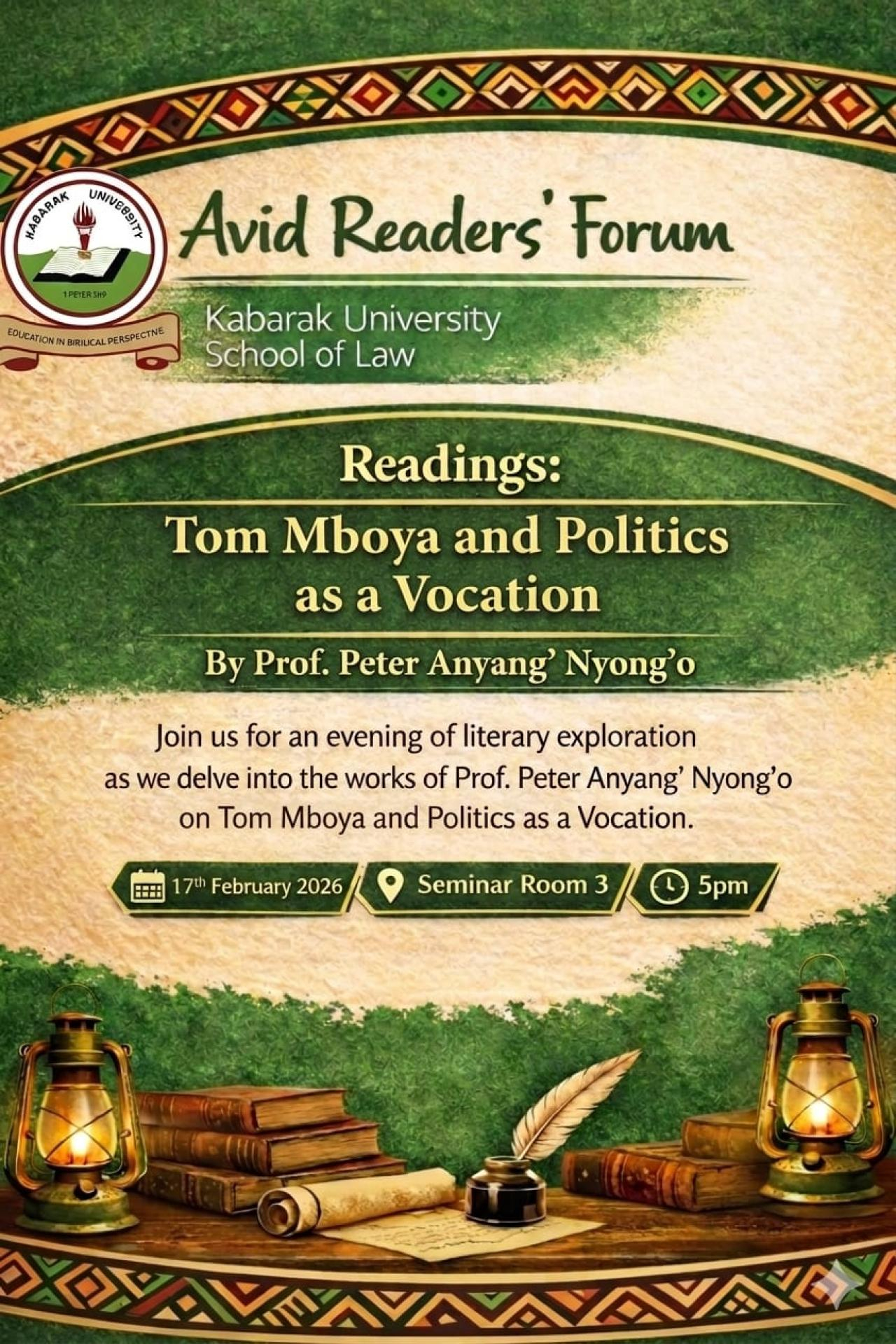
The third book club session of the year convened on 17th February. The evening involved a critical engagement with African leadership through the text: ‘Politics as a Vocation’, a lecture by Hon. Prof. Peter Anyang’ Nyong’o, excerpted from An Evening with Tom Mboya, published by the Kenya National Commission on Human Rights. This seminal text provided a deep, reflective tribute to one of independent Africa’s most respected statesmanship. The primary aim of the discussion was to explore the author’s nuanced analysis of Thomas Joseph Mboya’s life, not merely as a historical retrospective but as a dynamic and necessary interrogation of leadership ethics for contemporary Kenya. The discussants discussed the text, forming a dialogue on hope, betrayals, vision and the enduring ethical questions of leadership. The session was moderated by Joy Kemboi.
The discussion
The session opened with an exploration of Hon. Prof. Peter Anyang’ Nyong’o’s perspective on the political life and legacy of Thomas Joseph Mboya. The author emerged not merely as a historical actor but as an ethical proposition. His central argument, that Mboya embodied the ideal of politics as a vocation, a selfless calling to serve a greater cause rather than a profession, formed the core of the discussion. Mboya’s conception of leadership was anchored in vision, intellectual discipline, and moral principle. It was aimed at achieving national development for the sake of the country and its citizens irrespective of personal cost or gain. The discussants contrasted this view with the Author’s original intended title, “Tom Mboya: The Ultimate Politician”, noting that Prof. Nyong’o wisely rejected it for its connotation of political self-interest. Instead, Mboya was presented as a leader driven less by political maneuvering and more by a profound, noble social goal.
The participants interrogated the durability of such a vision. Mboya’s political career was remarkable for its consistent rejection of sectarian interests. Drawing from the author’s recount of Mboya’s detribalized politics, the discussants discussed how Mboya successfully won elections in diverse, non-Luo dominated constituencies, such as Nairobi East (later Nairobi Central) in 1957, 1961 and 1963. These victories, which often occurred in predominantly Kikuyu or diverse ethnic areas, were achieved not through ethnic mathematical calculations but by campaigning on ideas, service and a broad appeal that even reached Kenyan Asian voters. His leadership exemplified a core tenet: that a leader’s value lies in their ability to unite, not divide. The forum observed that Mboya represented a rare intellectual influence on the global stage, using his intelligence and clarity of thought to interpret the ‘new Africa’ to a skeptical West. The author detailed Mboya’s impressive list of international achievements before the age of 30, including his crucial role in founding the All-African Peoples’ Conference and his successful advocacy for South Africa’s expulsion from the Commonwealth in 1961 following the Sharpeville Massacre. The discussion did not romanticize him, acknowledging the Author’s admission that all great statesmen have faults, but it reaffirmed that his unwavering focus on non-alignment, economic development, and nation-building demonstrated that an alternative political trajectory based on service was, and is possible. In a political culture often defined by cynicism and short-term profit, the author’s reflections on Mboya’s disciplined refusal of tribal fragmentation and corruption (‘no kitu kidogo’) appeared as an urgent meditation for modern governance.
From this meditation on leadership, the discussants discussed the painful historical and contemporary realities presented by Prof. Nyong’o. A key illustration of Mboya's visionary leadership was his personal commitment to education, particularly through his organization of the Kenya Student Airlift Programme that started in 1958. This initiative, supported by his relationships with global figures like Martin Luther King Jr. and the Kennedy Foundation, gave hundreds of young Kenyans access to higher education in the United States. The author highlighted Mboya’s determination to ensure that talented young people from less privileged backgrounds could receive higher education abroad, linking his personal conviction that ‘knowledge, not money, is what pushes a country forward’ with practical action. This intellectual rigor was also reflected in Mboya’s own formidable debating skills, which were widely acknowledged even by his opponents. It was sadly noted that the current generation of leaders often view politics as a business, and public service without personal profit sounds outlandish. The author contrasted Mboya’s dedication, exemplified by his pivotal role in founding trade unions like the Kenya Local Government Workers Union and his strategic success in anti-apartheid movements at a very young age, with the ‘vicious wars to make money’ seen among later leaders who have missed their vocation.
Conclusion
The discussants concluded that Mboya’s tragic assassination at the tender age of 39 reflected the dangerous pull that has consumed many who live into old age, ultimately reinforcing that Kenya must desperately retrace Mboya’s steps toward prioritizing intellectual development and selfless service. He was a man who took politics as a calling and not a business. The session reaffirmed that Mboya was neither a ‘Kenyan Luo nor an African politician, but a citizen of the world’, and that his call to elevate the dignity of Africans in the world remains an essential mandate.
Prepared by: Asheen Chepkosgei, student at Kabarak Law School and Sessional Rapporteur.
