

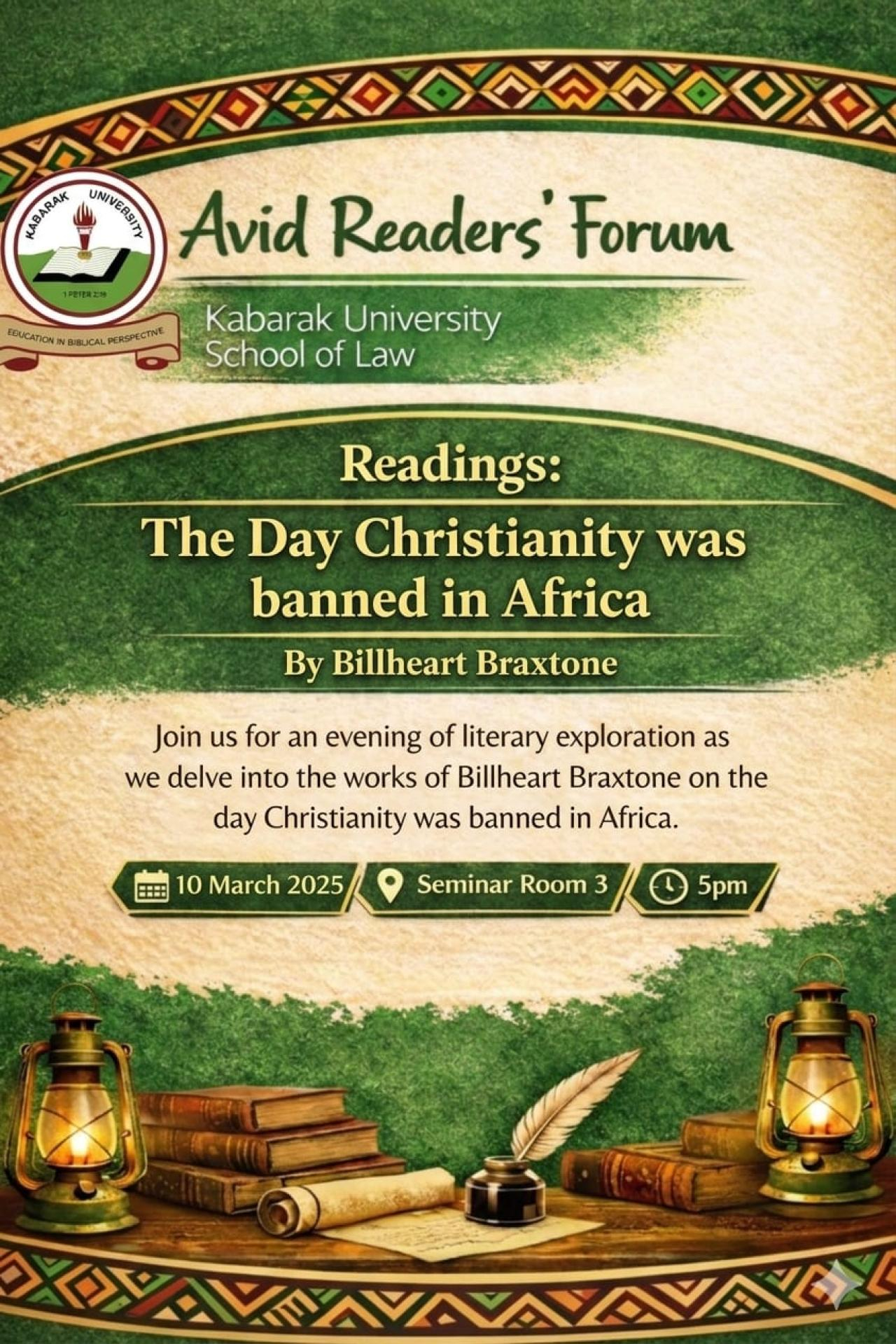
The Avid Readers’ session of 10 March featured a reflective and imaginative piece authored by a member of the Forum, Billheart Braxtone, titled ‘The Day Christianity Was Banned in Africa.’ The reading emerged as a response to earlier discussions within the Forum that had largely critiqued the historical and contemporary impact of Christianity on the African continent. In contrast, the author sought to present a more introspective and ultimately affirmative perspective on the place and resilience of Christianity in Africa.
From the onset, the narrative drew participants into a speculative yet unsettling reality, one in which Christianity, deeply woven into the social and cultural fabric of African life, is abruptly outlawed. The text did not merely present fiction; it invited the Forum to interrogate the depth, authenticity, and future of faith in Africa.
The Discussion Session
The discussion opened with reflections on the subtle build-up to the ban, as depicted in the text. Participants noted how the gradual shifts, billboards proclaiming ‘faith must evolve’, media discourse reframing religion as inefficiency, and the emergence of institutional neutrality, mirrored contemporary global conversations around secularism and modernisation. The Forum observed that the strength of the narrative lay in its quiet progression, where disruption did not arrive violently but through coordinated, almost imperceptible cultural shifts.
A central thread of the discussion focused on the tension between institutional religion and personal conviction. The banning of Christianity exposed the fragility of faith when tied to structures such as churches, gatherings, and public expressions. Yet, as the narrative unfolded through the character of Victory, participants observed a contrasting theme, the resilience of internalized belief. The participants reflected on whether African Christianity today is sustained more by routine and community or by deeply examined conviction.
The character of Victory became a focal point of analysis. Her journey through doubt, exploration of other belief systems, and eventual return to a refined and conscious faith sparked conversations about religious identity, pluralism, and authenticity. Participants noted that her encounters with Islam, Hindu philosophy, and Buddhism were not framed as antagonistic, but as sincere intellectual and spiritual engagements. This, the members observed, elevated the narrative beyond mere defense of Christianity into a broader reflection on the search for truth in a pluralistic world.
Another significant dimension of the discussion centered on the role of adversity in shaping belief. The Forum noted that rather than eroding faith, the ban appeared to distill it. Private gatherings, whispered prayers, and reconstructed scripture from memory illustrated a form of faith that is less performative and more deliberate. This led to the reflection that persecution, historically and contextually, often strengthens rather than weakens religious conviction.
Participants also engaged with the symbolic elements of the narrative such as the eclipse, the dreams, and the shifting language of policy, which were seen as metaphors for uncertainty, transition, and the contest over meaning and identity. The Forum appreciated how these elements blurred the line between the spiritual and the socio-political, suggesting that the fate of religion in Africa cannot be understood in isolation from broader cultural and institutional dynamics.
At a deeper level, the discussion returned to the author’s initial motivation: to respond to critiques of Christianity in Africa. Members acknowledged that while earlier sessions highlighted the problematic legacies of Christianity including colonial entanglements and cultural disruptions, the present reading offered a counterbalance by emphasizing its embeddedness, adaptability, educational and existential significance within African societies.
Conclusion
The session concluded with a recognition that “The Day Christianity Was Banned in Africa” is not merely a speculative narrative but a provocative reflection on the nature of faith, identity, and resilience. It challenges readers to consider whether belief is sustained by structure or conviction, and whether its absence in public life diminishes or deepens its meaning. The session reaffirmed the Forum’s commitment to engaging with diverse and even contrasting perspectives, recognizing that understanding complex issues often requires holding critique and affirmation in tension. At the end of the session, the author, Billheart was invited to share his inspiration behind the story and Victoria Okeke concluded with a vote of thanks to the attendees.
