

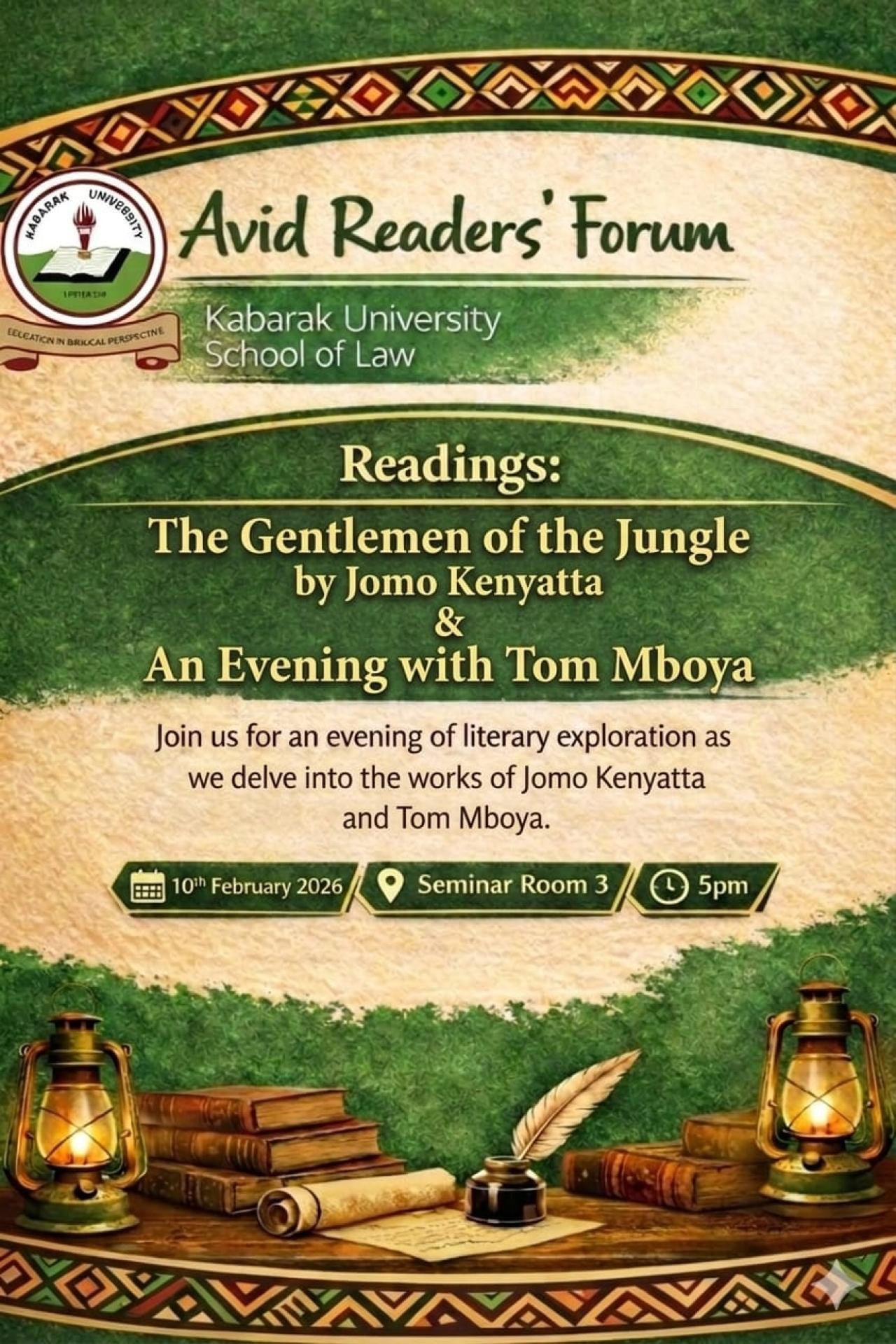
The second Agora session of the year convened on 10 February 2026 and was facilitated by Youngreen Peter Mudeyi and Lewis Ndichu. The evening involved a critical engagement with African leadership through two texts: An Evening with Tom Mboya published by the Kenya National Commission on Human Rights, and The Gentlemen of the Jungle by Jomo Kenyatta. The texts formed a dialogue between hope and betrayal, vision, dispossession, leadership, and power.
The discussion
The session opened with an exploration of Tom Mboya’s political imagination as captured in his quotes. Mboya emerged not merely as a historical actor but as an ethical proposition. His conception of leadership was anchored in vision, intellectual discipline, responsibility, and an unwavering commitment to national development. He imagined a Kenya that could transcend ethnic arithmetic and resist the reduction of politics into tribal calculus. Leadership, in his view, was not performance but stewardship and accountability.
The participants interrogated the durability of such a vision. A speculative but pressing question animated the room on whether Mboya’s leadership would have resisted the gravitational pull that has consumed many post-independence African leaders, if he had lived into old age. Would he have remained faithful to the ideals of pan-African solidarity and democratic accountability, or would he have also been absorbed into the architecture of patronage and power consolidation? The discussion did not romanticize him, yet it acknowledged that his insistence on inclusivity, foresight, and national unity suggested the possibility of an alternative political trajectory. In a political culture often defined by expediency, Mboya’s thought appeared as a disciplined refusal of ethnic fragmentation and short-term populism.
From this meditation on leadership, the discussion shifted into allegory. Kenyatta’s The Gentlemen of the Jungle unfolded like a parable whose simplicity concealed its severity. The elephant’s request to place his trunk inside the man’s hut seemed innocent, almost courteous, yet the courtesy was strategic. Gradually, the elephant displaced the man entirely, claiming the hut on the basis of size, strength, and supposed superiority. The rightful owner was cast into the rain and told that his tougher skin made him more suited to hardship. Participants observed that the jungle was not merely a setting, but a political order. The animal represented a power hierarchy, and justice was administered by those already aligned with dominance. When the man sought redress, the tribunal was composed of the elephant’s allies. The verdict was inevitable. Law did not function as an instrument of fairness but as a mechanism of legitimacy. Colonial dispossession, the forum noted, was often effected not only through violence but through legal rationalization. The language of civilization and justice masked the logic of expropriation. A central theme that emerged was the illusion of justice. Can justice exist where adjudication is monopolized by the oppressor? The story’s answer was sobering. Procedure without representation becomes theatre, and judgment without equality becomes decree. Justice requires not only rules but balanced power and genuine representation. Without these, the law degenerates into a vocabulary of domination.
Reflections from the two texts
The juxtaposition of Mboya’s political philosophy with Kenyatta’s allegory produced a layered insight. If the man in the jungle symbolizes the colonized subject dispossessed by incremental encroachment, then Mboya represents the intellectual counterforce. He represents the disciplined leadership required to reclaim space, dignity, and self-determination. Where the elephant manipulates law to entrench power, Mboya calls for leadership that subjects power to ethical restraint. One text diagnoses dispossession while the other gestures toward reconstruction. The forum reflected on how colonial logics persist in postcolonial formations. The method may change, but the pattern of capture remains familiar. Power enters through a narrow opening, justified as temporary or necessary, and soon occupies the entire structure. The allegory thus transcended its historical setting, inviting participants to consider contemporary governance structures and the subtle ways in which institutions can be appropriated.
Conclusion
As the session drew to a close, Victoria Okeke offered concluding remarks, synthesizing the evening’s insights and reaffirming the Agora’s commitment to interrogating power through literature and political thought. Cedric Kadima delivered the vote of thanks, acknowledging both returning members and first-time participants, and formally called the meeting to a close. The second Agora session did more than revisit historical figures. It staged a confrontation between dispossession and possibility. In the jungle, power justified itself and called it justice. In Mboya’s thought, leadership justified itself only through service and national purpose. Read together, the texts posed a demanding question: Will African politics remain a jungle governed by size and strength, or can it be transformed by vision, discipline, and accountable leadership?
Edited by: George Skem, ARF Senior Rapporteur & Finalist, at Kabarak Law School
