

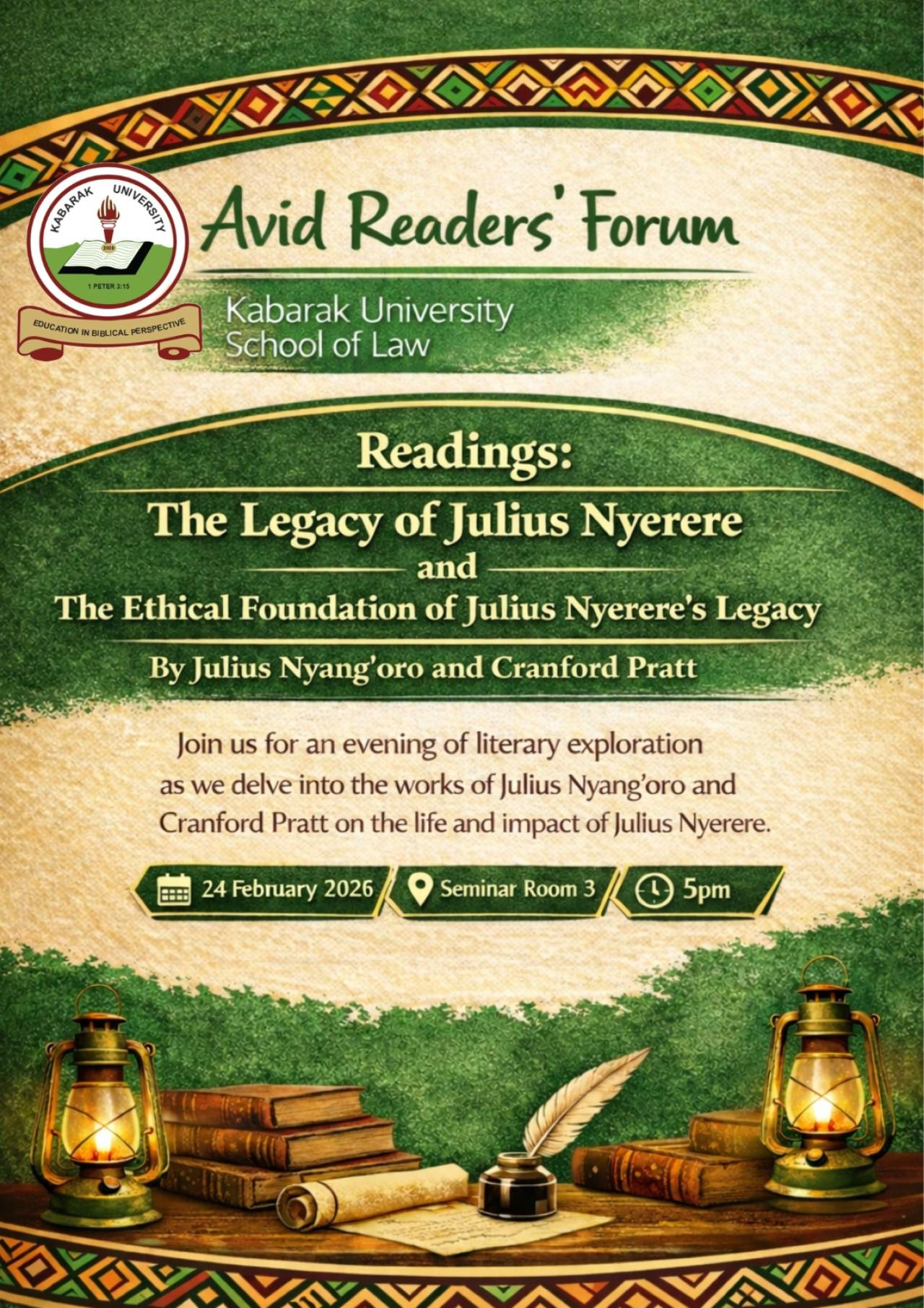
The evening session of 24 February began with a summary of Mwalimu Julius Nyerere’s background from Jimmy Wambua who was the facilitator of the session. A reflection of what it means to inherit a vision and its burdens hit the room as the narration by the two authors were read, making it the central guest in the room. The texts did not simply recount history; they demanded that we confront the paradox of leadership, vision, and the stubborn realities of development.
The Discussion Session
The readings were chapters three and two of two different books; Julius Nyang’oro’s ‘The challenges of development in Tanzania: The legacy of Julius Nyerere’ in The legacies of Julius Nyerere: Influences on Development Discourse and practice in Africa, David McDonald and Eunice Sahle (eds) and ‘The Arusha Declaration’ in Julius Nyerere’s Ujamaa: Essays on socialism, respectively. With both chapters being discussed together and Nyerere’s providing context to Nyang’oro, the first movement of the conversation centered on Ujamaa socialism. Nyang’oro’s analysis revealed both the audacity and fragility of Nyerere’s development project in Tanzania. Participants reflected on the attempt to craft a uniquely African path to modernity anchored in communal values rather than capitalist competition. Yet the challenges of villagization, economic stagnation, and industrial underdevelopment exposed the tension between moral clarity and practical governance.
The discussants noted that Nyerere’s legacy cannot be reduced to economic metrics alone. His insistence on self-reliance, equity, and national unity was not merely policy but philosophy. The reflections highlighted how his leadership sought to resist dependency on external powers, even when this resistance came at material cost. At this point, the participants confronted a pressing question: was Julius Nyerere a dictator or an authoritarian leader? The debate was animated. Some argued that his one-party system and forced villagization carried authoritarian traits. Others countered that his leadership was rooted in moral conviction, national unity, and a refusal to exploit power for personal gain. The forum did not settle on a single answer, but acknowledged the complexity of Nyerere embodying both the discipline of visionary leadership and the rigidity of centralized authority.
The position of Nyang’oro presented a diagnosis of developmental challenges and philosophical reflections. On one hand, Nyerere embodied the ethical refusal to reduce politics to tribalism or opportunism. On the other, his economic policies revealed the difficulty of translating moral clarity into sustainable growth. The authoritarianism debate provided another dimension of leadership in Africa often oscillating between vision and control. Nyerere’s legacy forces us to ask whether strong central authority is always oppressive, or whether it can sometimes be the scaffolding needed to build unity in fragile postcolonial states. Participants noted that while Nyerere’s methods could be coercive, his refusal to enrich himself or entrench tribal divisions distinguished him from many leaders who used authoritarianism for personal gain. Another reflection emerged around the durability of ideals. Can a nation sustain a moral vision when economic pressures demand compromise? Nyerere’s Tanzania showed that ideals can inspire unity, but without material success, they risk being dismissed as impractical. Yet, as the forum observed, abandoning ideals altogether risks leaving nations vulnerable to external capture and internal fragmentation.
Conclusion
The facilitator Jimmy, then concluded by synthesizing the insights: Nyerere’s vision remains a moral compass, even if its economic outcomes were uneven and its methods contested staging a confrontation between ideals and outcomes, between the dream of Ujamaa and the stubborn realities of development. As the discussion ended, members were to think through first, whether African nations can craft development models rooted in their own values, or they will remain houses built with borrowed bricks. Second, in pursuing unity, how do we guard against the slide into authoritarianism? At the end of the session, Asheen Tanui offered the vote of thanks, acknowledging the courage of participants to engage with uncomfortable truths about leadership, vision, and economic reality.
