Department of Medical Laboratory Sciences.
The Department of Medical Laboratory Sciences at Kabarak University is committed to producing highly skilled, ethical, and innovation-oriented professionals in healthcare diagnostics, forensic investigation, and biomedical research. We combine rigorous academic training with extensive practical exposure, ensuring graduates are well-prepared for dynamic roles in Kenya and globally.
Our teaching and research are driven by a team of competent and experienced lecturers and professors with specialized expertise across clinical, forensic, and molecular sciences. Faculty members bring a wealth of experience from academia, research, industry, and professional practice, ensuring our students receive education that is both academically rigorous and industry-relevant.
Objectives
- To deliver high-quality education in biomedical sciences, equipping students with the necessary skills and knowledge for successful careers.
- To conduct innovative research that pushes the boundaries of knowledge and contributes to solving healthcare issues.
- To establish fruitful local and international collaborations to enhance academic and research endeavors.
- To engage with the community through impactful healthcare outreach programs, addressing the needs of underserved populations.
Values
Our core values include integrity, excellence, innovation, and collaboration. These principles guide our academic and research pursuits, ensuring ethical practice and fruitful collaborations.
Facilities and Learning Resources
The department boasts state-of-the-art facilities designed to support quality teaching, research, and innovation:
- Specialized Teaching Laboratories for microbiology, histopathology, clinical chemistry, hematology, molecular biology, and forensic analysis.
- Molecular Diagnostics Laboratory is equipped for PCR, sequencing, and advanced genetic analysis.
- Forensic Science Training Suite simulating real-world crime scene investigations.
- Modern Research Laboratories are integrated into Kabarak University s Research, Innovation, and Outreach ecosystem.
Research, Innovation, and Industry Linkages
The department is firmly anchored in advancing laboratory diagnosis as the cornerstone of quality healthcare and disease control. Our teaching, training, and research emphasize accurate, timely, and evidence-based diagnostic practices that support effective patient management, public health surveillance, and outbreak response. Alongside this core focus, the department is actively engaged in applied research addressing both national and global health and forensic science challenges.
Through strategic collaborations with hospitals, public health laboratories, forensic laboratories, regulatory bodies, and industry partners, students gain hands-on experience in modern diagnostic techniques and evidence analysis. These partnerships provide invaluable mentorship in innovation-driven projects, equipping graduates with the skills to develop impactful, practical solutions that strengthen healthcare systems and enhance justice administration.
Main Academic Programmes
- Bachelor of Science in Medical Laboratory Sciences (Direct Entry)
- Bachelor of Science in Medical Laboratory Sciences (Upgrading / In-service Entry):
- Bachelor of Science in Forensic & Molecular Sciences
- Diploma in Medical Laboratory Sciences
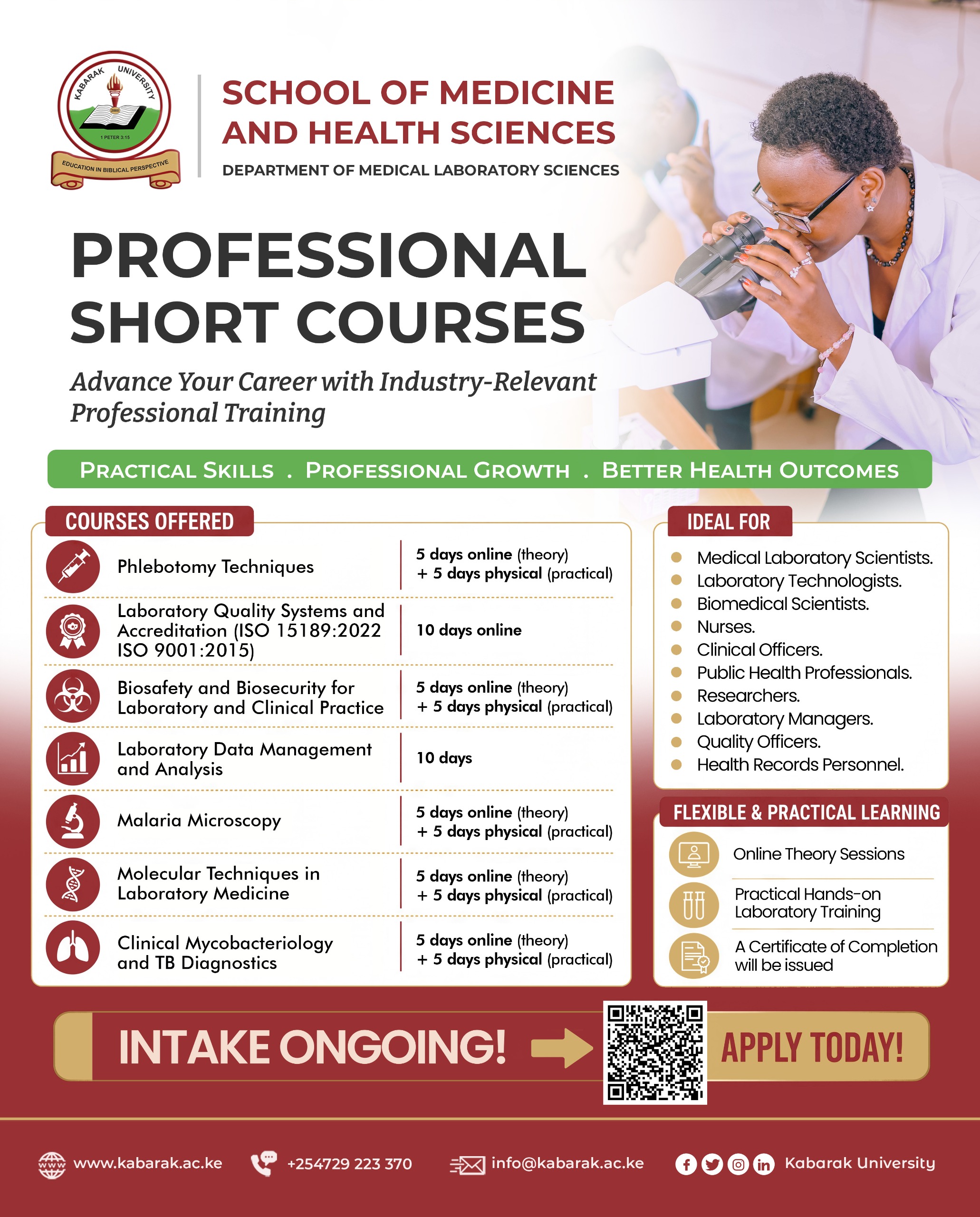
Professional Courses
|
COURSE NAME |
WHO QUALIFIES TO BE TRAINED |
MODE OF TEACHING |
|
Medical Laboratory Scientists and Technicians; Nurses; Clinical Officers; Biomedical Science students; Health workers involved in specimen collection |
5 days online (theory) + 5 days physical (practical) |
|
|
Laboratory Quality Systems & Accreditation (ISO 15189:2022; ISO 9001:2015) |
Medical Laboratory Scientists; Laboratory Managers; Quality Officers; Biomedical Scientists; Hospital Administrators; Health facility managers |
5 days online (theory) + 5 days physical (practical) |
|
Biosafety and Biosecurity for Laboratory and Clinical Practice |
Laboratory personnel; Clinicians; Nurses; Public health officers; Research staff; Infection prevention and control officers |
5 days online (theory) + 5 days physical (practical) |
|
Laboratory staff; Health records officers; Data clerks; Biomedical scientists; Public health professionals; Research assistants |
5 days online (theory) + 5 days physical (practical) |
|
|
Medical Laboratory Scientists and Technicians; Biomedical Science students; Public health laboratory staff; Research assistants in parasitology |
5 days online (theory) + 5 days physical (practical) |
|
|
Medical Laboratory Scientists; Biomedical Scientists; Laboratory Technologists; Researchers; Final-year laboratory students |
5 days online (theory) + 5 days physical (practical) |
|
|
Medical Laboratory Scientists; TB laboratory personnel; Biomedical Scientists; Public health laboratory staff; Research assistants in microbiology |
5 days online (theory) + 5 days physical (practical) |
Applications are ongoing. Join Kabarak University and invest in skills that make a difference in healthcare and laboratory practice. Click here to apply
